
Birth-chart compatibility, often called synastry, compares two natal charts as a symbolic way to explore a relationship. If astrology is meaningful to you, it can offer questions about affection, communication or the kind of life you want to share. It cannot decide whether someone loves you or guarantee a lasting match.
A fuller comparison looks beyond Sun signs. It also needs careful attention to the chart data and the actual angular distances between placements. The examples below show that geometry using invented placements, followed by a free calculator you can try.
Start with two charts and clear permission
A natal chart is calculated for a birth date, time and place. Ask before using or sharing another person’s details, and avoid requesting unnecessary identity documents or private records. Use consistent zodiac and chart settings when comparing the results.
Without a reliable birth time, the ascendant and houses are uncertain, and a Moon placement may also need checking for that date. Do not invent a precise time to make a match look better. Our natal birth-chart guide explains the main chart components and time limits.
Eight places to begin a conversation
Astrologers use these symbolic associations in different ways. Turn them into questions rather than conclusions about your partner.
1. Sun
Theme: Identity and purpose.
Which values do I want a relationship to make room for?
2. Moon
Theme: Comfort and emotional needs.
How do we each prefer to receive care or reassurance?
3. Mercury
Theme: Communication and interpretation.
How do we clarify a misunderstanding?
4. Venus
Theme: Affection, pleasure and values.
What kinds of shared time or affection do we each enjoy?
5. Mars
Theme: Initiative, desire and disagreement.
How do we express a wish or handle a difference without pressure?
6. Ascendant
Theme: Approach and first impressions.
How did we meet, and what have we learned beyond that first impression?
7. Jupiter
Theme: Growth and possibility.
What opportunities do we want to explore together?
8. Saturn
Theme: Limits, responsibility and commitment.
Which agreements are realistic and freely chosen?
There is no Jupiter placement that guarantees good luck together or Saturn contact that ensures a relationship will last. A Venus–Mars interpretation cannot establish sexual attraction or consent. Similar placements do not remove the need to ask what each person wants.
Aspects are angles, not just matching sign names
Each zodiac sign spans 30 degrees in the standard twelve-sign division of the 360-degree circle. An aspect compares the longitudes of two points. Astrologers commonly discuss conjunctions at 0°, sextiles at 60°, squares at 90°, trines at 120° and oppositions at 180°.
An orb is the allowed deviation from an exact aspect. Astrologers use different orb rules depending on the method, points and aspect. “Within 10 degrees” is not one universal rule that makes every pair significant. Being in the same sign also does not automatically create a close conjunction.
A trine or sextile may be interpreted as ease or opportunity; a square or opposition may raise questions about differences. A conjunction blends themes and is not automatically peaceful. None of these labels is a verdict that a relationship is good, bad or destined.
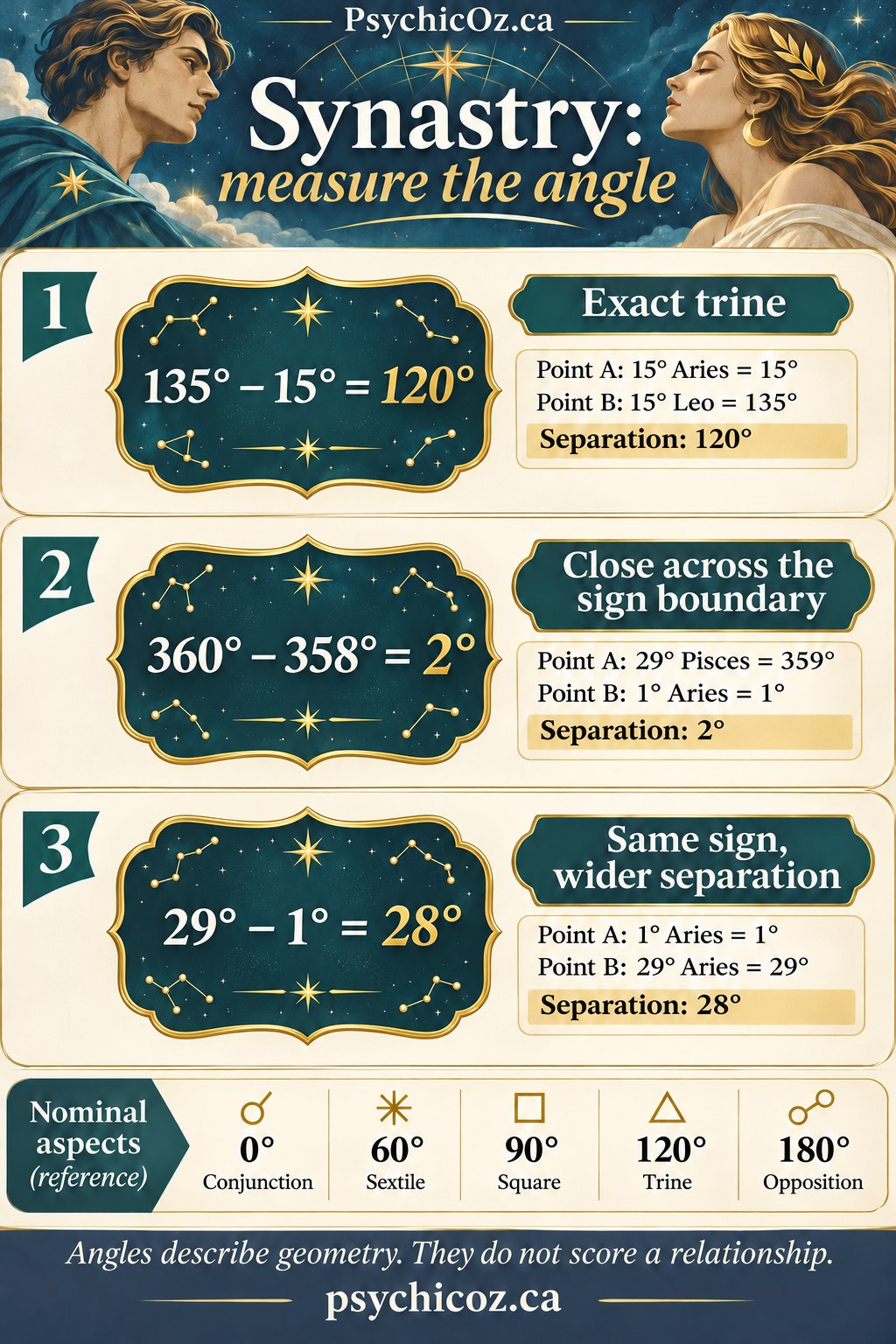
Four worked placement examples
These examples explain the measurement; they are not real people’s charts or compatibility scores.
1. An exact trine
A point at 15° Aries has longitude 15°. A point at 15° Leo has longitude 135°. Their shorter angular separation is 120°, an exact trine. You could explore what feels easy while still checking actual behavior.
2. Close across a sign boundary
29° Pisces is 359°, while 1° Aries is 1°. The shorter separation is 2°, near a conjunction despite the different signs. Whether to count it depends on the orb and interpretive method used.
3. Same sign, wider separation
1° Aries and 29° Aries are 28° apart. Sharing the sign does not make them a close conjunction. Check the degrees rather than assuming the sign name settles it.
4. A Venus–Mars sextile example
Venus at 10° Taurus has longitude 40°; Mars at 10° Cancer has longitude 100°. Their separation is 60°, an exact sextile. That geometry does not prove mutual desire or a future relationship.
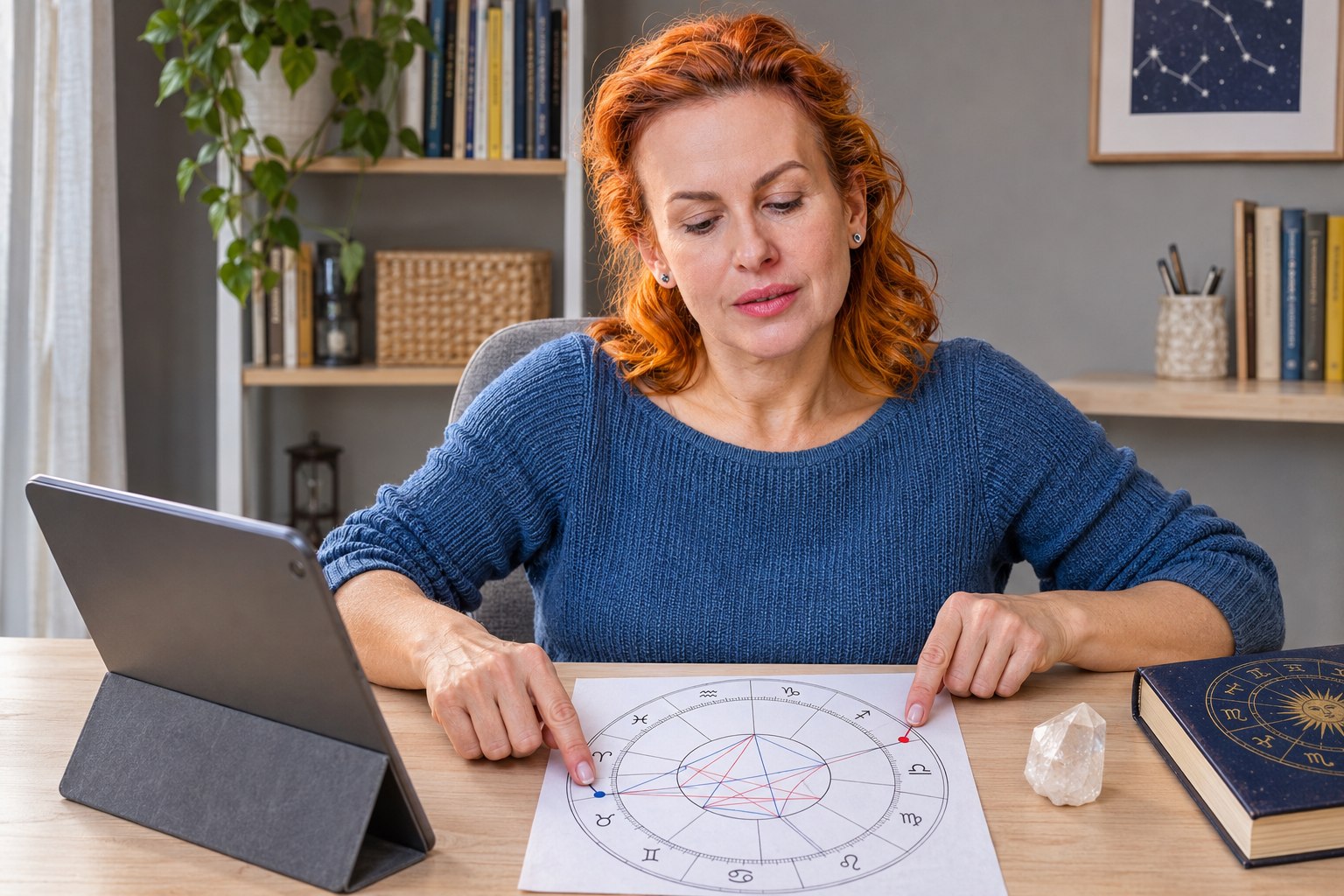
Free placement-angle calculator
Enter two placements from charts you already have. This calculates their shorter angular separation and distance from the nearest nominal major-aspect angle. It does not calculate a birth chart, choose an orb rule or score compatibility.
Use degrees from 0 up to, but not including, 30. The calculator uses only these selections on this page and does not send or save them.
Bring the symbols back to the relationship
After comparing a few placements, ask about an ordinary situation. “How would you like us to handle changed plans?” is more useful than “Your Mars makes you angry.” Listen for the person’s account and leave room for an interpretation not to fit.
Communication, shared plans, reliability and freedom to say no matter regardless of the chart. Love is respect’s boundary guidance offers questions grounded in what people actually do. No aspect excuses control, establishes fidelity or requires someone to stay.
Use astrology to open a conversation you both welcome. For a lighter individual exercise, see twelve zodiac dating prompts. You can value a spiritual perspective while leaving the relationship’s choices with the people in it.
Frequently asked questions
1. What is synastry?
It is an astrological comparison of two natal charts used to explore relationship themes symbolically.
2. Can a birth chart prove we are compatible?
No. It cannot establish love, consent, safety or a guaranteed future. Consider how you actually treat each other.
3. Why look beyond Sun signs?
A full chart includes other placements, angles and houses. These can add symbolic questions, but they do not determine behavior.
4. What do Moon, Venus and Mars describe?
Astrologers commonly use them for themes of comfort, affection and initiative or desire. Ask what fits rather than assuming the person must match a symbol.
5. Does matching Jupiter guarantee good luck?
No. A symbolic association with growth or opportunity does not establish a lucky relationship.
6. Can Saturn make a relationship last?
No. Commitment and workable agreements remain choices, not guarantees supplied by a placement.
7. Does the same sign always mean a conjunction?
No. Two points in one sign can be widely separated. Check their degrees and the orb rules used.
8. Can different signs be close to a conjunction?
Yes. For example, 29° Pisces and 1° Aries are only 2° apart by the shorter arc. Whether to count it depends on the method and orb.
9. What are trines and sextiles?
Their exact angles are 120° and 60°. They may be interpreted as ease or opportunity, but they do not promise harmony.
10. Is every conjunction a peaceful aspect?
No. Its interpretation depends on the points and the wider chart, and no aspect guarantees an outcome.
11. Is 10 degrees the correct orb for everything?
No. Orb rules vary with the method, points and aspect. There is no single 10-degree rule for all pairs.
12. Does the calculator create birth charts?
No. You supply two existing placements. It calculates their shorter angular separation and distance from the nearest nominal major-aspect angle.
13. What if I do not know my birth time?
Avoid firm claims about the ascendant and houses. Check whether a Moon placement could change during that day, and do not invent a precise time.
14. Can synastry establish someone’s sexual interest?
No. An aspect does not establish attraction or consent. Ask and respect the person’s actual choices.
15. Should I share someone else’s birth information?
Ask permission and protect privacy. You do not need identity documents or unrelated private information for a reflective chart discussion.