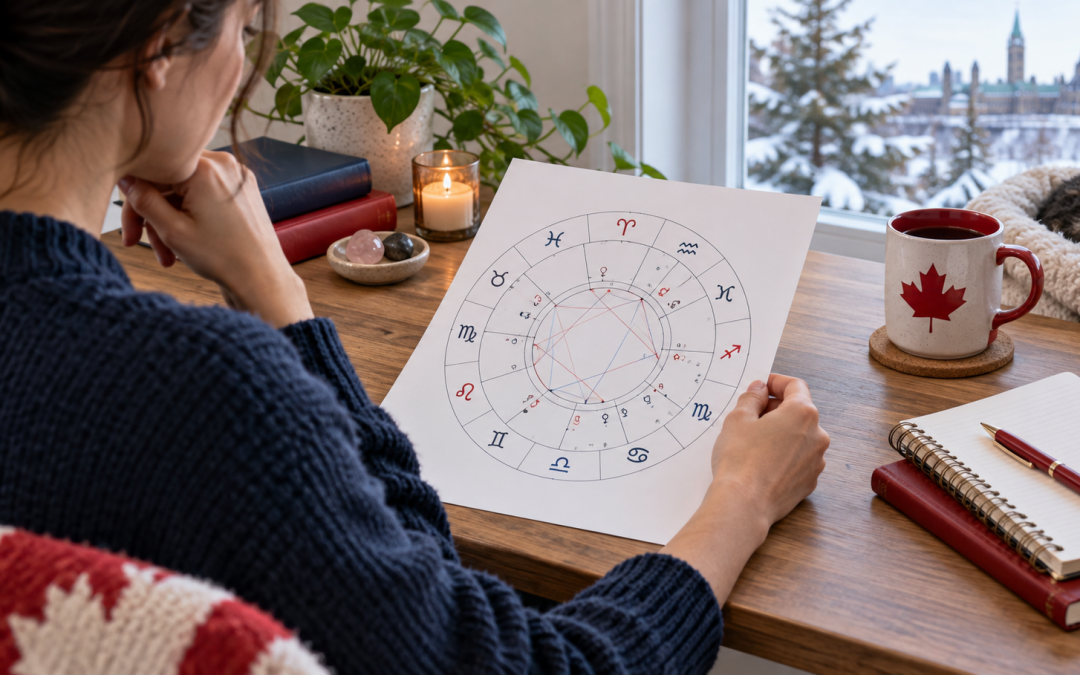
A natal birth chart is an astrological map calculated for a date, time and place of birth. Astrologers use the positions of the Sun, Moon and planets within zodiac signs and houses as symbols for reflecting on temperament, relationships and life themes.
A chart does not scientifically determine personality or predict a fixed future. Use it as a structured language for reflection, then compare every interpretation with your lived experience and choices.
What information a birth chart needs
A chart calculator normally asks for:
- the calendar date of birth;
- the local time of birth;
- the city or coordinates of birth;
- the correct time zone and daylight-saving status.
You do not need to give identity documents, account passwords or unrelated private information to obtain a chart.
Why birth time matters
The birth time affects the rising sign and house cusps because those points change as Earth rotates. A small time difference may change house placements, especially when a point is near a boundary.
The Sun and slower-moving planets will not become useless if the exact minute is unknown. An unknown time simply limits which parts of the chart can be interpreted confidently.
What to do when the time is unknown
Check a birth record, family archive or ask relatives, while recognizing that memory can be approximate. If no reliable time exists, use an “unknown time” chart and avoid firm claims about the rising sign and houses.
Some astrologers offer birth-time rectification based on life events. Treat the result as an interpretive estimate, not recovered proof.
The Sun: central identity themes
In modern astrology, the Sun sign is often associated with vitality, purpose and conscious identity. It is the sign most people know from a birth date.
A Sun sign does not describe a whole person. People born under the same sign have different histories, cultures, bodies, opportunities and choices.
The Moon: emotional and habitual themes
The Moon is commonly read through needs, emotional rhythms, memory and private life. Use these ideas to ask what helps you feel secure and how you respond under stress.
Do not use a Moon sign to diagnose attachment, trauma or mental health.
The rising sign: presentation and approach
The ascendant, or rising sign, is the zodiac sign rising on the eastern horizon at the calculated birth time. Astrologers often link it with first impressions, style and the way a person meets new situations.
Because it depends strongly on time and location, uncertainty should be stated clearly.
The personal planets
- Mercury: communication, learning and interpretation.
- Venus: attraction, values, pleasure and relating.
- Mars: initiative, conflict, desire and effort.
These are symbolic associations. A placement cannot establish how someone communicates, consents or behaves in a relationship.
The social and outer planets
Jupiter and Saturn are often read through growth, limits, opportunity and responsibility. Uranus, Neptune and Pluto move more slowly, so entire age groups share sign placements; astrologers look to houses and aspects for a more personal reading.
No planet guarantees wealth, disaster, addiction, illness or spiritual status.
The twelve houses
Houses divide the chart into twelve areas. Common topics include identity, resources, communication, home, creativity, routines, partnerships, shared matters, belief, public life, community and private reflection.
House systems differ, and the same planet may appear in another house when a different system is selected. Ask which system a chart uses.
Aspects
Aspects are measured angles between chart points. Astrologers interpret some as flowing and others as tense, though no aspect is purely good or bad.
A square might prompt questions about friction and effort; a trine might prompt questions about ease or underused ability. Neither dictates an event.
A five-layer reading order
- Confirm the date, time, place and chart settings.
- Read the Sun, Moon and rising sign as broad themes.
- Notice planets in signs and houses.
- Choose a few major aspects rather than interpreting everything.
- Turn the interpretation into questions and observable examples.
This prevents one dramatic placement from controlling the whole reading.
Use examples, not labels
Instead of “Capricorn makes you serious,” ask, “Where do responsibility and long-term effort show up in your life?” Then look for supporting and contradicting examples.
A good interpretation allows the person to say no. It does not force their experience into a stereotype.
Personality is more than a chart
Personality develops through biology, learning, family, culture, relationships and circumstances. Astrology offers symbolic categories, not a validated personality test.
Do not use a birth chart to screen employees, diagnose children or excuse harmful behaviour.
Can a chart predict the future?
Astrologers may study transits, progressions or returns to describe themes and timing. These techniques do not establish that a specific event will happen.
Use a forecast to generate questions: What needs preparation? What evidence would change the plan? What remains outside my control?
High-stakes decisions
Do not use a chart alone to choose medication, invest, sign a contract, accuse someone, decide a pregnancy or assess safety. Use qualified professionals, direct communication and current evidence.
A difficult transit is not a medical diagnosis or emergency prediction.
Relationships and compatibility
Synastry compares two charts, but it cannot establish consent, fidelity or whether a relationship is safe. Observe mutual interest, boundaries, reliability and repair.
No “destined” aspect obligates someone to stay or return.
Career and money
A chart may prompt reflection on work style or priorities. It cannot identify the only correct career or guarantee income.
Combine reflection with skills, training, labour conditions, finances and small real-world experiments.
Asteroids and additional points
Some astrologers add asteroids, nodes and calculated points after understanding the main chart. More symbols do not automatically produce more accuracy.
If you want to explore them, see this guide to Sedna, Ceres, Pallas, Juno and Vesta in astrology.
Numerology versus astrology
Numerology assigns symbolic meaning to numbers derived from dates or names. Astrology maps celestial positions for a time and location. They are separate interpretive systems.
This comparison of life path numbers and zodiac signs shows how to use both without blending them into one claim.
A grounded home chart session
Sit at a home-office desk with the chart, a notebook and reliable birth data. Choose one topic and set a 20-minute timer. Write the interpretation, one supporting example, one contradiction and one question.
Step into the yard or take a short walk afterward before making decisions. Reflection benefits from a return to ordinary context.
Questions to ask an astrologer
- Which zodiac and house system do you use?
- How do you handle an uncertain birth time?
- Will you distinguish symbolism from factual advice?
- What is the total price and session length?
- Do you avoid guaranteed outcomes and diagnoses?
Keep account credentials and unnecessary identity details private.
A 30-day chart experiment
- Choose one constructive chart theme.
- Define a small behaviour connected with it.
- Practise twice a week.
- Record what supports and contradicts the interpretation.
- Keep what helps and release what does not.
The chart is a prompt. Your actions and feedback provide the evidence.
Frequently asked questions
What is a natal birth chart?
It is an astrological map calculated for a birth date, time and location. Astrologers interpret signs, houses and aspects as symbolic themes.
Is an exact birth time required?
An accurate time is important for the rising sign and houses. If it is unknown, use a time-unknown chart and avoid confident claims about those features.
Can a birth chart determine personality?
No. It can offer reflection prompts, but personality is shaped by many factors and astrology is not a validated personality assessment.
Can a natal chart predict my future?
No chart can guarantee a future event. Use forecasts as questions for planning, then rely on current evidence, consent and qualified advice for decisions.